Tax information exchange is rarely the subject of popular debate. It carries the weight of technical acronyms — EOIR, AEOI, CRS, MAAC — that tend to confine the discussion to specialists. Yet, for Africa, this conversation is deeply political.
Exchange of information (EOI) goes to the heart of fiscal sovereignty, of who gets to tax whom, and of whether African states can enforce their own laws against well-resourced actors who move capital across borders with impunity. Framed correctly, EOI is not merely an administrative cooperation tool. It is a safeguard for effective taxing rights — one that, in its current design, is only partially functioning for the continent.
The Numbers Tell Part of the Story
According to the Tax Transparency in Africa 2025 report published by the Organisation for Economic Co-operation and Development (OECD’s) Global Forum, African countries sent 1,756 EOI requests in 2024, nearly doubling the 888 requests recorded in 2023 and representing a historic high. Since 2009, African members of the Global Forum have identified at least EUR 4.2 billion in additional revenues through tax transparency measures.
Thirty-nine African countries are now members of the Global Forum, 24 are parties to the Multilateral Convention on Mutual Administrative Assistance in Tax Matters (MAAC), and the continent is connected through a growing network of Tax Information Exchange Agreements (TIEAs) and regional instruments under ECOWAS, WAEMU, SADC, ATAF, and CEMAC. These are often presented as achievements.
Truly, they reflect genuine institutional progress, sustained political commitment, and the growing awareness among African tax administrations that cross-border tax transparency is indispensable. However, this progress must be read against a strong backdrop of issues raised by several stakeholders.
The Gap Between Formal Inclusion and Effective Access
Despite the so-called positive trajectory, EOI in Africa remains structurally lopsided. In 2024, less than half the continent was actively sending requests, and two countries alone accounted for 79% of all requests sent by the region. Only 6 African countries had commenced exchanges under the Common Reporting Standard (CRS) as of January 2025, with just 12 committed to do so by 2026.
Meanwhile, Africa loses an estimated USD 88.6 billion annually to illicit financial flows (IFFs), representing approximately 3.7% of its GDP. The High-Level Panel on Illicit Financial Flows from Africa, chaired by former President Thabo Mbeki, estimated losses of USD 50 billion annually, with over one trillion dollars drained from the continent over three decades. The disconnect between formal institutional participation and actual revenue recovery reflects structural design flaws in the global EOI architecture — flaws that disproportionately affect African tax administrations.
Three Structural Barriers to Effective EOI in Africa
1. The “Foreseeable Relevance” Trap: The standard governing Exchange of Information on Request (EOIR) requires requesting countries to demonstrate the “foreseeable relevance” of the information sought. In theory, this prevents fishing expeditions. In practice, it creates a paradox: African administrations are asked to partially know what they are trying to discover.
Where investigative capacity is already limited, this standard raises the bar for access to information beyond what most administrations can clear. The Tax Justice Network has long argued that such standards, while ostensibly neutral, function as de facto barriers for developing-country jurisdictions. A more developmental approach would allow for group-based or pattern-based requests and lower evidentiary thresholds for administrations with documented capacity constraints.
2. Confidentiality Standards as Gatekeeping Mechanisms: Under the CRS, countries must meet strict data protection and confidentiality standards before receiving automatic information flows. The effect is exclusionary: many African countries are deemed non-compliant with a flawed peer-review mechanism and are therefore denied access to the very information they most urgently need.
The global financial secrecy infrastructure is overwhelmingly located in developed economies — the United States alone accounts for 24.54% of the global financial secrecy market, according to the Financial Secrecy Index 2025.1.
Under the current bilateral activation mechanism, these same jurisdictions retain the power to selectively decline to enter into exchange relationships with African counterparts, citing data protection concerns that are not applied consistently to other partners. The result is structural exclusion dressed in technical language.
3. The Reciprocity Requirement and AEOI Asymmetry: The CRS operates on reciprocity: countries are expected to both send and receive information. This design presupposes an equally sophisticated financial sector and administrative infrastructure on all sides. For many African economies — particularly lower-income and smaller states — the obligation to provide information equivalent to what they receive is prohibitively demanding.
The State of Tax Justice 2024 report found that the world is losing USD 145 billion annually to offshore tax evasion, largely because the CRS has been implemented in a “flawed and partial” manner. African countries are frequently on the losing end of this asymmetry: they are required to invest heavily in systems that yield limited immediate returns, while financial centers that host the offshore wealth of African taxpayers continue to operate with limited obligation to share.
The UN Framework Convention: A Structural Opportunity
The ongoing negotiations on the UN Framework Convention on International Tax Cooperation represent the most significant governance opportunity in decades to correct these imbalances. Unlike OECD-led processes, which structurally exclude most African and Global South voices from standard-setting, the UN process is grounded in the principle of sovereign equality. All countries have an equal seat at the table.
At the Fourth Session of the Intergovernmental Negotiating Committee (INC), held in February 2026 in New York, exchange of information moved from a background assumption to front-line negotiating terrain. A significant structural development had already taken place: following sustained advocacy by civil society and developing-country delegations, EOI was elevated from a sub-provision of Article 9 on Mutual Administrative Assistance into a dedicated standalone article — Article 10. That elevation is not merely editorial. The Africa Group has been clear about what Article 10 must deliver. Speaking through Zambia, the Group moved to strike language conditioning exchange commitments on feasibility, arguing that such hedges reproduce in treaty law the very flexibility that financial centres have long exploited to delay or deny exchange with African partners.
Equally, the Group tabled replacement text that reframes capacity not as donor-driven technical assistance but as implementation infrastructure—a shared legal obligation of all State Parties encompassing technology transfer, exchange-of-information systems, legislative support, and predictable financial assistance anchored in the needs of developing countries. The distinction is foundational: assistance is discretionary; infrastructure is a treaty commitment.
Article 10 also represents the most direct opportunity to dismantle the bilateral activation mechanism that has excluded African countries from automatic information flows, allowing financial secrecy jurisdictions to selectively decline partnerships with African counterparts.
The Africa Group's position is unambiguous: universal, non-discriminatory exchange must be the treaty default—not an opt-in arrangement controlled by wealthy jurisdictions. The Group has equally resisted attempts by developed-country delegations to invoke the risk of "duplication" with OECD frameworks as grounds for weakening ambition, insisting that an Article 10 that simply mirrors the Global Forum's peer-review architecture would not constitute reform but transcription.
As the zero draft is shaped ahead of INC5 in August 2026, African countries must ensure that Article 10 emerges as a structurally distinct commitment: binding, universally activated, asymmetrically designed, and adequately resourced — transforming EOI from a safeguard in name into one that functions in practice.
For EOI specifically, the Convention must go further than past instruments. It must embed asymmetrical reciprocity and special and differential treatment as core principles — allowing countries to receive information without immediate full obligations to share — and establish a funded mechanism, potentially under the United Nations Development Programme (UNDP), to support infrastructure development and human resource capacity in lower-income African economies. It must also address the bilateral activation mechanism head-on, moving toward universal participation without discriminatory carve-outs.
Beyond Capacity Building: A Sovereignty Argument
Much of the international discourse on EOI in Africa focuses on capacity: African administrations lack the technical staff, IT systems, and legal frameworks to engage effectively. This framing is not incorrect, but it is incomplete. As the foundational paper underpinning this piece argues, the current EOI system was not designed around the operational realities of African tax administrations. It was designed by and for developed-country systems and then extended globally with technical assistance as a palliative measure. The challenge for Africa is therefore not simply one of capacity deficiency; it is one of system design.
EOI, as currently architected, reflects a particular set of power relationships in global finance. Reforming it requires political will from financial centres, not only administrative improvements in African capitals. Expanded EOI scope — beyond financial accounts to include real estate, beneficial ownership of legal vehicles, crypto-assets, and complex investment structures — is equally necessary, as tax evasion strategies are already migrating to non-reportable asset classes.
Conclusion: From Safeguard in Name to Safeguard in Practice
EOI can indeed be a strong safeguard for African taxing rights. The architecture exists. The political momentum is building. African countries are joining global forums, signing conventions, and sending more requests than ever before. Yet, the gap between formal participation and effective access to information remains wide enough that billions of dollars in taxable wealth continue to evade detection every year.
Making EOI work for Africa requires systemic reform: standards, asymmetrical reciprocity, mandatory universal activation of exchange relationships, expanded scope, simplified processes, and adequate financial support.
The UN Framework Convention is the most credible vehicle currently on the table. African countries must use the INC process to ensure that EOI provisions in the Convention are not simply replications of existing OECD frameworks but genuine structural innovations that serve the continent’s fiscal sovereignty. The question is no longer whether exchange of information is relevant for Africa. It is whether Africa can transform an instrument of formal inclusion into one of effective protection.
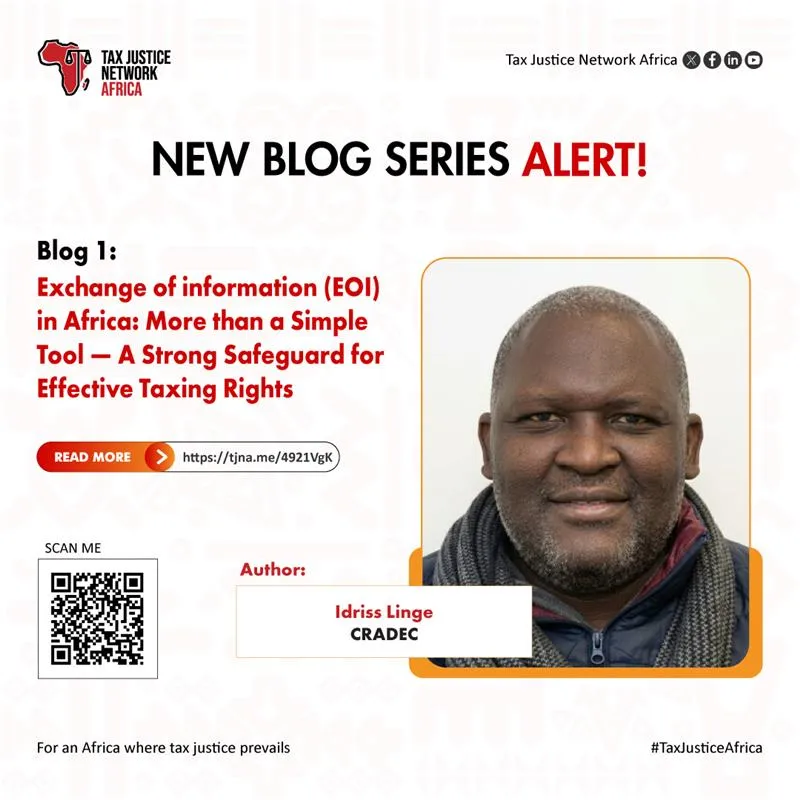
This blog is authored by Idriss Linge of the Centre Régional Africain pour le Développement Endogène et Communautaire (CRADEC), from Yaoundé, Cameroon.
For more information, please contact Everlyn Muendo at emuendo[@]taxjusticeafrica.net.
