



Why is public country-by-country reporting important for Africa?
Multinational corporations (MNCs) are undoubtedly powerful actors in global trade and the global economy. A 2013 UNCTAD study found that MNCs control 80% of global value chains. A further 2019 study illustrated that about one-third of global output is contributed to by MNCs. In Africa, there has been a rapid expansion of MNCs, with one author estimating that the increase of foreign affiliates has grown by 250% since the global financial crisis in 2008.
The common narrative is that MNCs have positive benefits such as increasing employment, technology transfer among other socio-economic benefits. The equally undeniable truth is that the presence of MNCs has had significant negative effects including irreparable environmental damage, labour abuses, weakening of domestic competitors and in some cases, even the increase in political instabilities. On top of this, they take part in harmful tax practices that severely erode the tax bases of these countries. Yet there is very little empirical evidence on them. This is simply because a lot of this data on the operations of this MNC is not collected, especially on a geographical basis.
The local corporate governance laws of countries where MNCs are present will often require companies to file their annual returns. This means that the affiliates present in Kenya will provide single-entity accounts. While the single-entity accounts of an MNC may be reported in Kenya, this may not help Kenyan tax officials to understand the full operations of the MNC in Mauritius, South Africa, Rwanda, and so forth. To be able to access such information, one might assume that consolidated financial statements of the MNC could be helpful. However, this information is still not enough for tax purposes. Financial/ commercial accounting and tax accounting, which are developed for different purposes i.e. for shareholders or potential investors and for compliance with local tax laws can lead to different results. The former incentivises maximising profits to show financial health while the latter incentivises minisimg profits to reduce taxes paid. The disparities in the profits reported versus the amount of tax paid is one of the things that sparked calls for tax justice.
In several cases, this meant that MNCs were reporting more profits in countries where there was very little real economic activity particularly tax havens and less profits in countries in high tax jurisdictions where there was significant economic activity. Several MNCs have been exposed for using tax havens to shift profits for tax purposes. This was illustrated through investigations such as the Mauritius leaks.
A number of African governments had not been able to detect these activities due to the limitations of reporting that did not allow them to see the full operations of MNCs beyond their own jurisdictions, or to detect that profit shifting was taking place. Public country-by-country reporting (CbCR) is meant to bridge this gap by allowing particularly Global South governments to get additional information that would help them gauge whether the taxes paid in their countries coincide with the level of economic activity therein. Public CbCR was developed to enhance the understanding of the economic activities of MNCs in each country where they operate.
What is country-by-country reporting?
CbCR is a standard introduced whereby multinational corporations are required to publish data on their economic activities, profits made and amount of tax paid in each country in which they operate in. In summary, the following information is required from MNCs:
- Name of the MNC group, name of the country and the names of subsidiaries within that country
- Financial performance that indicates the level of real economic activity including pre-tax profits, sales and purchases (both intra-group and third-party transactions), labour costs and the number of employees, financing costs and the value of assets
- The taxes paid within that country, among other more detailed information.
Public versus secret CbCR
Unravelling secret CbCR
CbCR standards can be classified into two main categories: Secret CbCR and public CbCR. The most prevalent standard for ‘secret’ CbCR was developed by the Organisation for Economic Cooperation and Development (OECD) standard and introduced through the Base Erosion and Profit Shifting (BEPS) package in 2015.
According to this standard, CbCR information is limited to exchanges between tax administrations and is not publicly available. Several African countries have adopted this standard as a result of being members of the Inclusive Framework of BEPS.
As of March 2026, at least 18 African countries have introduced domestic legislation in their efforts towards implementing the OECD CbCR. Despite this, CbCR has not been very effective in Africa. To understand why, it is necessary to delve further into the structural barriers of secret CbCR.
Why secret CbCR is not working for Africa?
To understand the inadequate effectiveness of the OECD CbCR in Africa, one must first understand its design. The following are the main issues:
- Unpacking the threshold: Only large MNCs that have a consolidated revenue of more than 750 million Euros are subject to CbCR. African countries must adhere to this threshold if they wish to access CbCR information from other jurisdictions. This threshold covers only around 10% of MNCs meaning that an estimated 90% of MNCs are left out of scope. This unfortunately leaves out of scope many MNCs that operate in Africa which defeats the point of developing a transparency standard that is beneficial to African countries.
- Local filing requirements and exchange of CbCR requirements: As per the OECD rules, the jurisdiction in which the ultimate parent entity (UPE) of the group is located is required to introduce CbCR legislation. If it does so, then other jurisdictions in which the MNC group is present are constrained on their ability to require ‘local filing’ and will, most often, have to depend on the jurisdiction in which the UPE is based to exchange this information with them. For this to happen, there must be an exchange of information framework either bilaterally or multilaterally between African countries and other jurisdictions. Only Kenya, Mauritius, Nigeria, Senegal, Seychelles, South Africa and Tunisia have activated exchange of information on CbCR through the Multilateral Competent Authority Agreement (MCAA) on the automatic exchange of CbC reports. This means that out of 18 African countries 11 do not seem to have exchange of information relationships. Therefore, as per the OECD standard, local filing can only be permitted if the jurisdiction in which the UPE is based has not introduced CbCR legislation or if the agreements between the UPE jurisdiction and the other jurisdiction are ‘faulty’ or ‘incomplete’. Considering that UPEs are more present in Global North jurisdictions, this has greatly reduced the usefulness of CbCR for African countries. This means there are very limited opportunities for local filing in Africa.
- Confidentiality, appropriate use and data safeguards: Even if African countries ensure that they have exchange frameworks in place for exchange of information on CbCR, they will not be fit to receive this information, unless they have data and confidentiality safeguards. Only a handful of African countries seem to have met the OECD confidentiality and data safeguards as per the peer reviews. This measure does nothing but exacerbate information asymmetries while increasing administrative pressure for tax authorities that are stretched thin on resources.
- Limited use of CbC reports: Implementation of CbCR requires heavy investment in setting up legal frameworks, exchange of information relationships, technological systems, human and technical resources. Yet despite this heavy investment particularly for smaller African countries, the use of CbCR reports would be strictly limited to transfer pricing risk assessment.
The initial vision and progress of public CbCR
Contrary to public opinion, CbCR predates the 2015 BEPS package. The roots of public CbCR can be traced to the tax justice movement and more broadly, the financial transparency movement. In the wake of the 2008 Global Financial Crisis, when the repercussions of a shadow financial system had shaken the world, the Taskforce for Financial Integrity and Economic Development launched a report titled: Country by country reporting: Holding multinational corporations to account wherever they are.
Most importantly, CbCR was originally envisioned to be publicly published. Currently, various jurisdictions have implemented some level of public CbCR. By 2013, the European Commission had already mandated public CbCR for the banking industry and as of 2021, this was further extended to other sectors of the economy. Unfortunately, the latter standard failed to meet the true essence of public CbCR. For instance, the EU standard allows MNCs to hold information that may be considered commercially sensitive for 5 years. Additionally, the EU standard allows for some level of aggregated data which goes against the spirit of CbCR which is to provide geographically disaggregated data. Most significantly, public CbCR is limited to reporting on activities in EU countries and a few jurisdictions that are deemed non-cooperative for tax purposes. This means that the EU standard will be of very little relevance to African countries since it does not cover all countries particularly, developing countries, where harmful tax practices cause greater harm.
Through the Global Reporting Initiative (GRI), we now have a global standard on public country by country reporting. The GRI standard is voluntary and remains available to MNCs and government regulators if they wish to implement it. This limits its effectiveness. Nevertheless, Australia is perhaps one of the few countries in the world that has managed to develop mandatory public CbCR. In 2024, the Australian government introduced legislation on public CbCR requiring MNCs with an Australian turnover of over 10 million dollars to publish information on key financial information, taxes paid, number of employees among other measures. However, the standard does allow for a certain level of aggregated reporting.
Despite the existing iterations of public CbCR, the ambition that civil society originally held for public CbCR has still not been matched.
Is there any hope for public CbCR for African countries?
It is no surprise that many African countries would respond with cynicism on the usefulness of CbCR, having mostly implemented secret CbCR. However, there is hope that CbCR can still meet the potential it was meant to reach. Currently, there are ongoing negotiations on the UN Framework Convention on International Tax Cooperation (UNFTIC), a process that was spearheaded by the Africa Group with the aim of transforming the international tax system. This provides a prime opportunity to transform tax transparency in a way that works best for African countries by:
1. Establishing a global public CbCR standard: Only a standard that requires reporting in every jurisdiction without exception will meet its full potential. Public CbCR would drastically even out the playing field for many Global South countries and address the information asymmetries that make it difficult to effectively tax MNCs within the continent. The administrative measures to meet confidentiality standards would be done away with, and for the first time, tax authorities and other key stakeholders would have access to information on MNC operations at a granular level. While there is much controversy about this due to concerns about confidentiality, there is not much within the required data of CbCR that would be existentially a threat to businesses. The EU impact assessment confirms this. Additionally, other aspects such as the revenue threshold should be reviewed e.g. the definition of large multinationals at domestic level should replace the 750 million Euros threshold.
2. Establishing public CbCR as a standalone article: While CbCR appeared in the October 2025 proposed article on addressing harmful tax practices (through information sharing rather than a public standard), the recent January 2026 version of the same article had no mention of public CbCR. Public CbCR must be included as a standalone article rather than an element of any other commitments within the UNFTIC.
3. Expanding the use of CbCR information: The use of public CbCR as envisioned by civil society was meant to be much broader than risk assessment for transfer pricing abuse. Its benefits would not be limited to tax authorities alone but would simultaneously be beneficial to employees, shareholders, potential investors and other stakeholders such as investigative journalists and civil society. While the role of CbCR in deterring tax avoidance is critical, CbCR was envisioned to play a bigger role, providing a stepping stone to introducing profit allocation methods such as unitary taxation and formulary apportionment. Granular data such as the number of employees, their payroll, the value of assets, the number of users, the volume and value of sales could significantly make profit allocation much easier with the adoption of the unitary taxation and formulary apportionment. Further, it could be used for more than just tax purposes. It could be used for evaluating the trade and labour positions of developing countries in comparison with other countries where these MNCs were operating in.
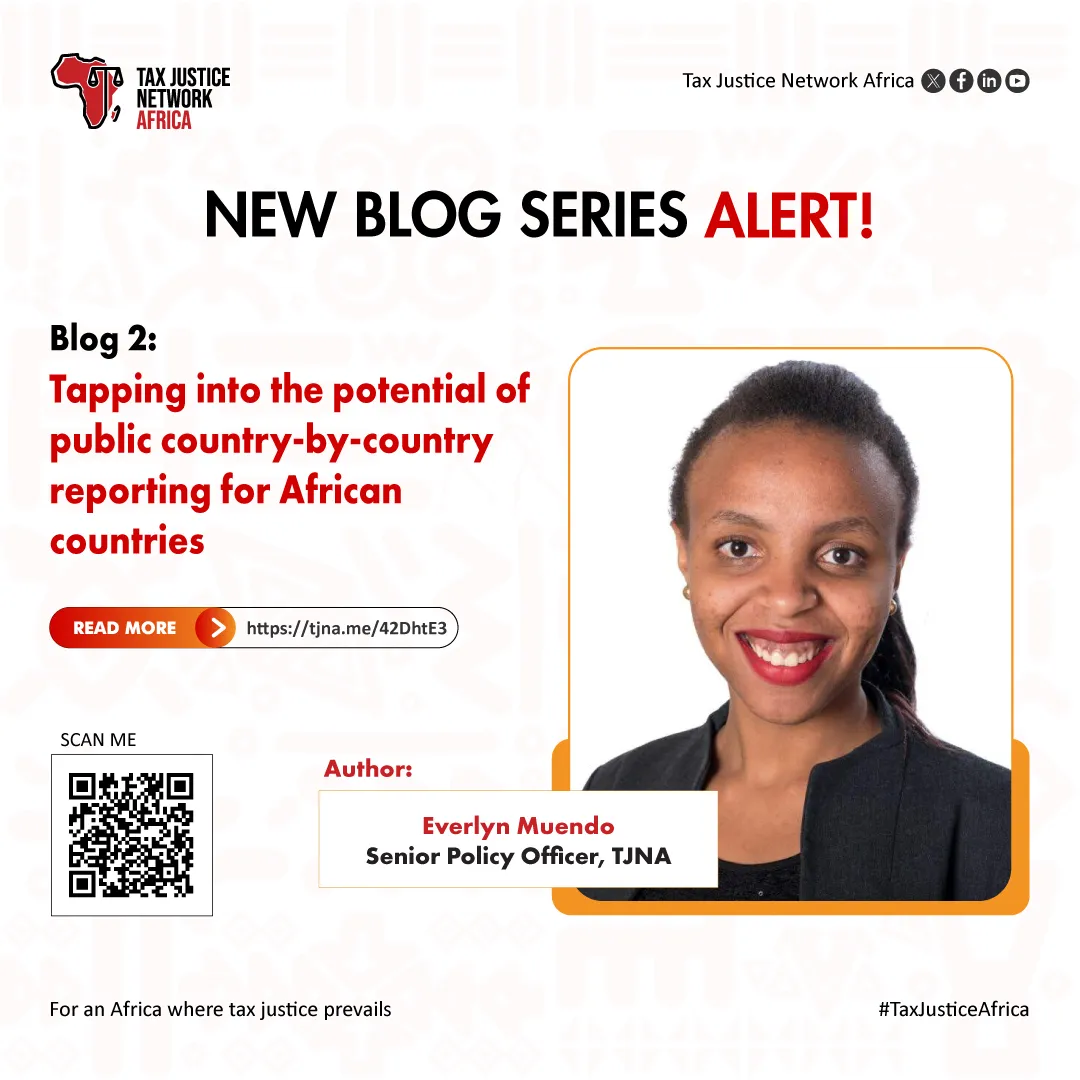
The author of this blog is TJNA’s Senior Policy Officer, Ms. Everlyn Kavenge Muendo.
For more information, please contact Ms. Muendo at emuendo[@]taxjusticeafrica.net.
