
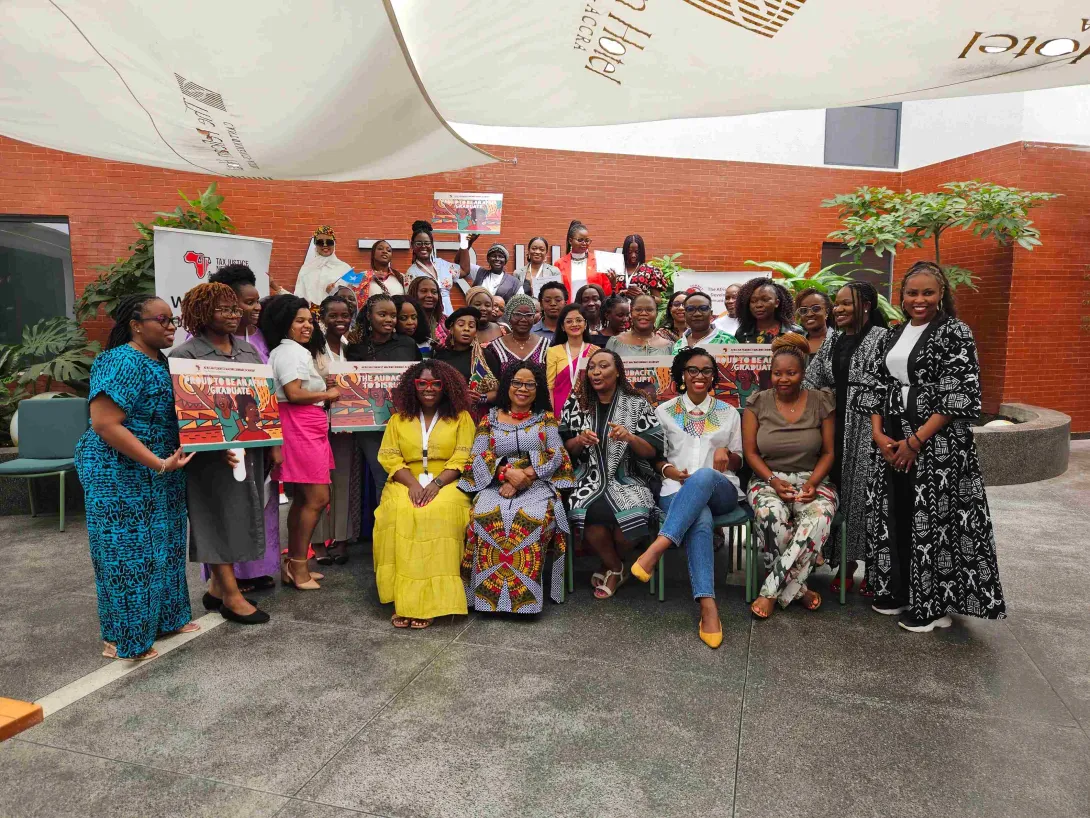
The Africa Feminist Macroeconomic Academy (AFMA) 2025 reinforced the urgency of feminist-led approaches to transforming Africa’s tax systems during this year’s convening, held from 18–22 August in Accra, Ghana.
Organised by the African Women’s Development and Communication Network (FEMNET) in collaboration with the Global Alliance for Tax Justice (GATJ) and the African Feminist Tax Initiative, the convening was under the auspices of Tax Justice Network Africa (TJNA) and the Nawi Afrifem Collective.
This year’s Academy aimed at advancing feminist approaches to tax justice and macroeconomic transformation. Organised under the theme “A Feminist Approach to Tax Justice: Reclaiming Public Resources for Gender and Economic Justice,” AFMA 2025 which brought together feminist movements, researchers, activists, and women’s rights organisations from across the continent to discuss structural inequalities, economic justice, and the need to reimagine economic systems that have long disadvantaged women and marginalised communities.
The academy opened with a grounding in African Feminism and feminist macroeconomics. Facilitators highlighted that African feminism is rooted in historical struggles for social justice and resistance to patriarchal, neoliberal, and capitalist systems, while remaining inclusive of the continent’s diverse lived realities. Participants were introduced to feminist macroeconomics as a framework that challenges mainstream economic models, which reproduce gendered, racialised, and class-based inequalities. The discussions emphasised the need for a shift from profit-centred economic thinking to systems that prioritise wellbeing, social protection, and ecological harmony. Ms. Omolara Oriye, who co-leads the work of Liberation Alliance Africa, reminded participants that the goal of feminist economic advocacy is not merely to seek equality within existing systems but to challenge and transform the structures that perpetuate inequality.
Building on this foundation, the programme moved into feminist political economy, with a special focus on social reproduction and taxation. Facilitators outlined how feminist political economy exposes the power dynamics and gendered hierarchies underlying economic structures. A key theme was social reproduction, encompassing biological reproduction, unpaid domestic labour, and paid care work, labour that sustains societies yet remains undervalued or ignored by formal economic policymaking. Ms. Leah Eryenyu, the Lead Gender-Just Economy Learning Community at Trust Accountability and Inclusion (TAI) Collaborative, elucidated that, this labour, disproportionately performed by women, becomes a site of exploitation under capitalist economies that rely on said labour while refusing to invest in it. Essentially, capitalism depends on social reproduction but is unwilling to pay for it.
Participants also explored the political economy of taxation in Africa, examining how global power imbalances, harmful tax incentives, and illicit financial flows undermine the ability of African countries to fund essential services. These failures have a deeply gendered impact, as women rely heavily on public services such as healthcare, childcare, and education. Conversations then delved into the historical and global roots of these issues, tracing how colonial tax systems replaced communal and redistributive pre-colonial models with extractive structures designed to benefit the metropole. This legacy continues to shape contemporary tax challenges, contributing to the growth of the informal sector and an over-reliance on regressive taxes like VAT.
Participants further reflected on the role of International Financial Institutions—particularly the IMF and World Bank—in entrenching inequalities through austerity policies and conditionalities that privilege corporate interests over public welfare. As Grace Arina of the Feminist Tax Initiative noted, dismantling these colonial legacies requires redirecting revenues to public goods, centring marginalised voices, tackling illicit financial flows, and shifting power from the Global North.
The academy also engaged with ongoing global and regional developments in tax governance. At the international level, participants analysed the UN resolution promoting inclusive and effective international tax cooperation, championed by the Africa Group, and the subsequent Terms of Reference for a UN Framework Convention on International Tax Cooperation. This development marks a significant milestone in the push for a fairer global tax system that better serves developing countries. Regionally, institutions such as the African Union and the African Tax Administration Forum (ATAF) were recognised for their efforts in tax harmonisation, digitalisation, and capacity building. Despite this progress, Africa continues to lose more than USD 89 billion annually to illicit financial flows, while most countries maintain tax-to-GDP ratios below 15%. As highlighted by TJNA’s Executive Director, Ms. Chenai Mukumba, Africa loses more money through commercial capital flight than it gains from foreign direct investment.
On the technical front, day three unpacked the political and often arbitrary nature of tax laws. Facilitators illustrated how corporate lobbying influences policy design and how seemingly simple legal definitions can determine tax liability, citing the British case of United Biscuits Ltd v Commissioners of Customs and Excise (1991), in which a debate ensued over whether a snack should be classified as a cake or a biscuit, which ultimately affected a 20% tax charge.
Participants further explored how different income types are treated unequally by tax systems: salaries are taxed at source with little flexibility, dividends often receive favourable treatment, and corporate tax obligations vary widely depending on incentives. These disparities demonstrate that tax systems reflect political choices rather than objective economic logic. Moreover, discussions on digital taxation, including where to tax multinational tech companies, further underscored the complexity and political nature of modern tax governance. As Dr. Lyla Latif, a pan-African lawyer, noted that taxation is not merely a technical exercise but a language game where definitions shape outcomes.
The final day of the academy focused on tax and gender, highlighting how African tax systems carry both implicit and explicit gender biases. Women bear a disproportionate burden of consumption taxes such as VAT, as they spend a larger share of their income on basic goods. Similarly, tax reliefs tied to formal employment exclude many women who work in informal, domestic, or unpaid sectors. Professor Abena Oduro, Associate Professor and Chairperson of the Graduate Committee in the Department of Economics at the University of Ghana, emphasised that addressing gender bias in tax systems requires designing policies and administrative processes that reflect women's lived realities. The academy concluded with a session led by Dr. Angella Azumah Alu, Fiscal Policy Advisor for Oxfam in Ghana, who outlined practical advocacy strategies for advancing feminist tax justice, including media engagement, evidence-based research, community mobilisation, targeted lobbying, and coalition building. She reminded participants that meaningful progress often demands sustained and consistent action.
AFMA 2025 reaffirmed the central role of feminist perspectives in reshaping Africa’s economic and fiscal landscapes. Through deep analysis, collective reflection, and strategic dialogue, participants strengthened their commitment to challenging unequal systems and advancing public resource mobilisation that centres gender and social justice. The academy closed with a renewed call to continue building feminist alternatives that transform not only tax systems but the broader economic structures that shape the lives of women and communities across Africa.
For more information about the Africa Feminist Macroeconomic Academy (AFMA) 2025, please contact Grace Arina at garina[@]taxjusticeafruca.net.
