
By Jephiter Tsamwi
Tax policy can help African governments advance their public health objectives. This connection was at the centre of discussions at the recently concluded 2nd Southern African Conference on Tobacco Taxation (SACOTT 2026) in Windhoek, Namibia, where delegates examined how taxes on tobacco and related products can protect public health while mobilising domestic revenue. It ended with a bold declaration calling for stronger tobacco tax structure, better tax administration and enforcement, and greater use of domestic resources to finance public health.
But perhaps the key question we need to answer is why should tobacco taxation matter to ordinary Africans, and who really benefits from it?
This question matters because discussions about tobacco taxation are often buried in technical terms which citizens cannot understand. However, behind the technical language are policy decisions that shape whether young people are protected from smoking initiation, whether families can afford healthcare and whether African governments can sustainably finance public services.
Why tobacco taxes matter
Tobacco taxation begins with a public health problem. According to the World Health Organisation 2026 Tobacco and Nicotine fact sheet, tobacco kills more than 7 million people each year, including over 1.6 million non-smokers who are exposed to second-hand smoke. The report further notes that around 80% of the world's 1.2 billion tobacco users live in low- and middle-income countries, making this subject peculiarly relevant to Africa.
Tobacco use is linked to cancer, heart disease, stroke, and chronic respiratory illnesses. Treating these conditions places pressure on public health systems, while families bear medical expenses, loss of income, and the responsibility of caring for relatives who become ill. Thus, the true cost of tobacco is therefore much greater than the price paid for a cigarette.
Well-designed tobacco taxes increase prices, discourage people from starting to smoke, encourage users to reduce consumption or quit, and generate additional public revenue. At #SACOTT2026, the Windhoek Declaration acknowledged that tobacco tax structures should progressively move towards the World Health Organization benchmark of tobacco taxes constituting at least 75% of the retail price, adjusted automatically according to inflation and income growth rates.

Reading of the conference declaration at the end of #SACOTT2026 in Namibia
A Practical Option for Financing Health in Southern Africa
When health ministers from ten Southern African Member States gathered in Windhoek in August for the 5th Regional Ministerial Steering Committee meeting, the diagnosis presented to them was stark. Regional economic growth averaged about 2% in 2024, debt-service obligations continue to limit what treasuries can allocate to essential services, health budgets remain below the Abuja commitment of 15%, and external financing still carries a significant share of the region’s health costs.
Africa CDC’s projections on financing health security and sovereignty identified health taxes and levies among several innovative financing options. Others included debt conversion, diaspora and health bonds, green financing and blended instruments. Importantly, the meeting stressed that any new financing mechanism should be assessed against additionality, cost, fiscal risk, predictability and governance.
TJNA participated in those discussions, whose recommendations closely connect with the objectives of SACOTT 2026. A few weeks later, tobacco-control advocates, researchers and policy institutions gathered in the same city with a practical proposition: tobacco taxation is already available to governments seeking more sustainable health financing.
Unlike many proposed financing mechanisms, tobacco taxes are already provided for in national laws, administered by revenue authorities and reviewed through annual budget processes across the region. They require no new financing architecture, sovereign guarantee or negotiation with external creditors. More importantly, they can raise domestic revenue while reducing the tobacco-related diseases that place growing pressure on health systems.
The policy instrument already exists. What remains is for governments to strengthen its design and administration, account transparently for the revenue it generates, and demonstrate the political will required to use it effectively.
Who should benefit?
Low-income households stand to gain significantly. Namibian Deputy Minister, Gender Equality and Child Welfare, Linda Mbwale summed up this when she said, “effective tobacco taxation presents governments with a powerful policy instrument capable of delivering multiple benefits – reducing tobacco consumption, discouraging people from starting to smoke, protecting families especially women from health challenges associated with tobacco use and generating additional revenue that can be used to support essential public services.”
Although tobacco taxes are sometimes criticised for placing a greater burden on poorer consumers, World Bank research (Titled Is Tobacco Taxation Regressive), which is based on extended cost benefit analysis (ECBA) methodology shows that for several countries, large price shocks on cigarettes coupled with smart policy design and implementation can generate progressive and welfare-improving medium and long-term net impacts, that particularly improve welfare of lower-income households
Another common argument is that stronger tobacco taxes will destroy jobs and harm the economy. Presenting the Zambia the Tobacco Excise Tax Simulation Model (TETSiM) analysis for Zambia at #SACOTT2026, Vanessa Darsamo of the University of Cape Town challenged this claim. She explained that tobacco manufacturing is largely capital-intensive, and that industry estimates of potential job losses are often overstated.
“The long-term economic and health gains far outweigh the short-term industry concerns,” she said. The industry may continue protecting its profits, but governments must consider the much wider costs borne by workers, families and public health systems.
TETSiM is an evidence-based tool that helps governments understand what could happen when they change cigarette taxes. Using country-specific information, it estimates how different tax policies may affect cigarette prices, affordability, consumption, smoking prevalence, and government revenue. This allows policymakers to compare possible reforms before implementing them. The report for Zambia was developed with support from Tax Justice Network Africa (TJNA) under its Tax and Health Strategic Focus Area (SFA)
What makes tobacco taxation effective?
Introducing tobacco tax does not automatically guarantee better health or increased revenue. Its impact depends on how the tax is designed, administered, and used.
If tax rates remain unchanged while inflation and incomes rise, tobacco products can become more affordable. Complicated tax structures can also allow consumers to switch to cheaper brands instead of reducing consumption.
Effective tax administration is equally important. Patrick Tongo of the Namibia Revenue Agency told delegates that tackling illicit trade “requires collective effort. We need to work together.” He highlighted the importance of digital tax stamps, track-and-trace systems, intelligence-led enforcement, and cooperation among customs and other law-enforcement agencies.
The impact of tobacco taxation also depends on what happens to the revenue collected. These benefits can be strengthened when part of the revenue is allocated to health, a practice known as earmarking.
At SACOTT 2026, TJNA Policy Associate for Tax and Health John Njenga captured its wider significance when he said, “Earmarking is sovereignty.”
Njenga stressed that earmarking must have a defined purpose and be integrated into a country’s public financial management system. Governments should report how much revenue was collected, where it was allocated, how it was spent, and what health outcomes it produced.
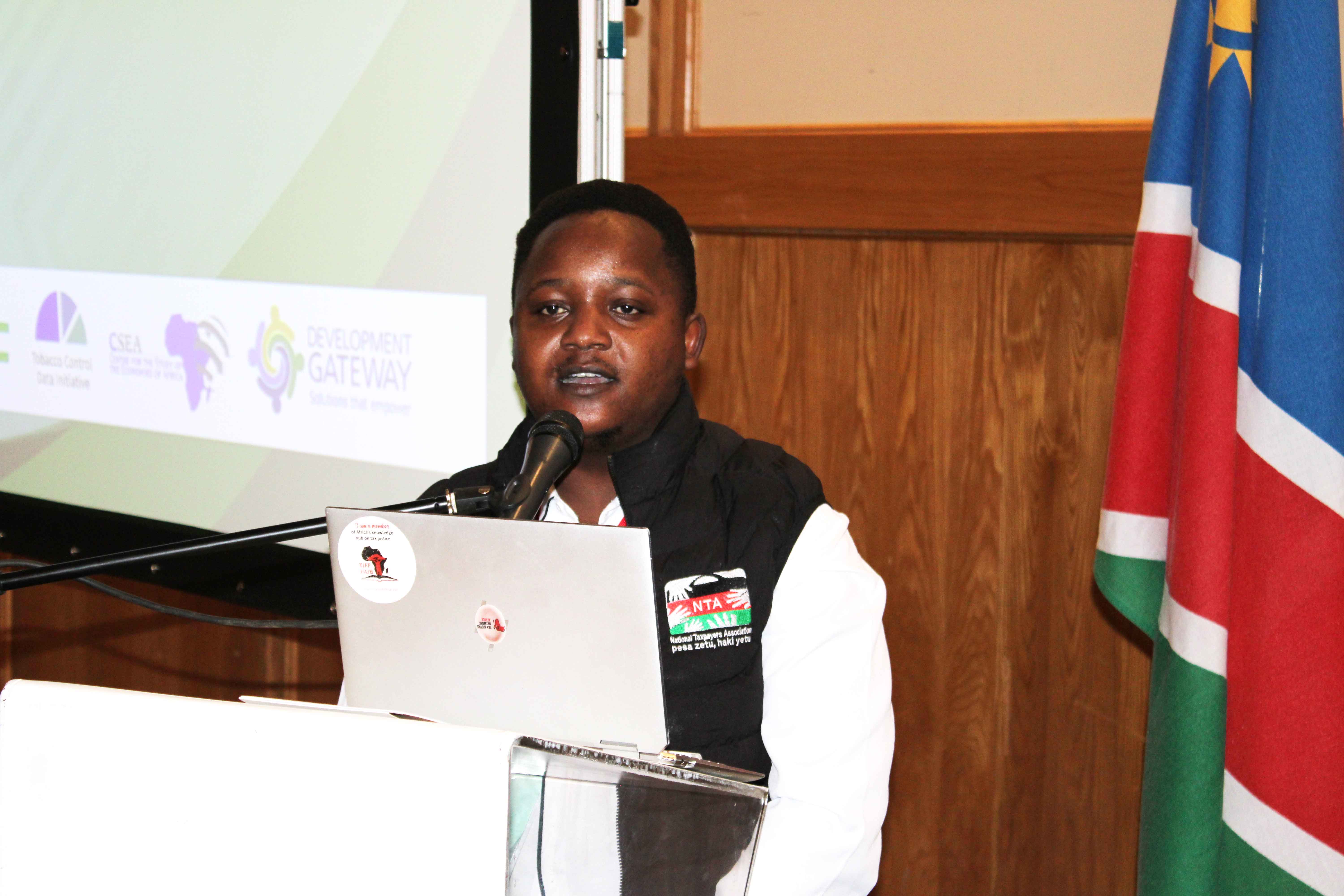
TJNA Policy Associate John Njenga sharing a presentation during SACOTT2026
The Windhoek Declaration therefore calls for a clear legal basis, defined beneficiaries, transparent management and public reporting wherever countries choose to earmark tobacco tax revenue. It also states that this funding should add to existing health budgets rather than replace them.
Finally, tobacco-tax decisions must be grounded in credible evidence. Prof. Hans Justus Amukugo of NAMDEF reminded participants that “whatever policy or system we develop, our decisions should always be based on evidence.” This is where the TETSiM, becomes valuable.
What Africa needs to do next
At SACOTT, Prof. Amukugo said, “Evidence alone does not make policy. Strong scientific evidence is necessary, but it does not automatically result in policy adoption.” Tobacco taxation involves competing interests among health and finance ministries, revenue authorities, farmers, manufacturers, civil society, and the tobacco industry.
TJNA Tax and Health Consultant Ina Kafunda challenged participants “not to run away from the political question.” She called on delegates to ask why policies remain unimplemented and why international instruments are not acted upon.
Nelson Zakeyu, Executive Director of Drug Fight Malawi, added the perspective of tobacco-growing countries. He argued that economic dependence on tobacco should not become permanent policy dependence. Governments must protect public health while helping farmers access viable alternative livelihoods.
For TJNA, these questions form part of the broader tax justice agenda. The organisation’s new strategy has established Tax and Health as a standalone Strategic Focus Area, recognising the connection between health taxes, domestic resource mobilisation, accountability, and Africa’s fiscal sovereignty.
TJNA’s role is not limited to calling for higher taxes but includes producing African evidence through initiatives such as TETSiM, supporting regional learning, challenging industry narratives and making technical policy discussions understandable to citizens through initiatives like the Pan-African Conference on Illicit Financial Flows and Taxation (PAC)
The Windhoek Declaration now provides a common direction. Its value will depend on whether countries strengthen their laws, improve enforcement, protect policymaking from industry interference, and account publicly for how tobacco-tax revenue is used.
Success should not be measured only by the amount collected but must also be measured by the young people who are not initiated to smoking, the families spared preventable medical costs, and the resources made available for stronger public health systems.
Those are the people who should really benefit.
For more information about TJNA’s Tax and Health strategic focus area, contact John Thomi on jthomi@taxjusticeafrica.net
