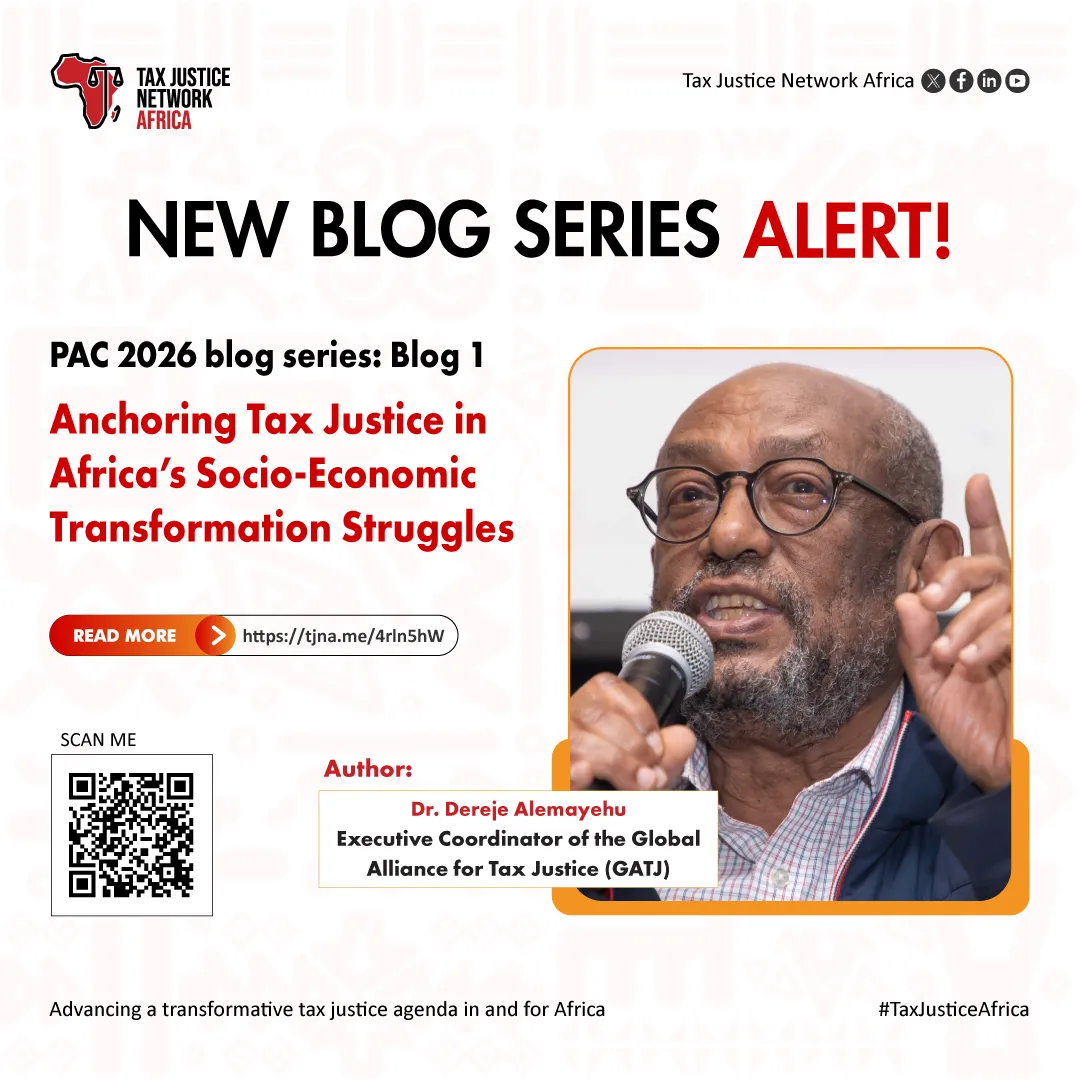
By: Dr. Dereje Alemayehu
Tax justice is not an end in itself but a means to an end. One of these ends is to contribute to structural economic transformation.
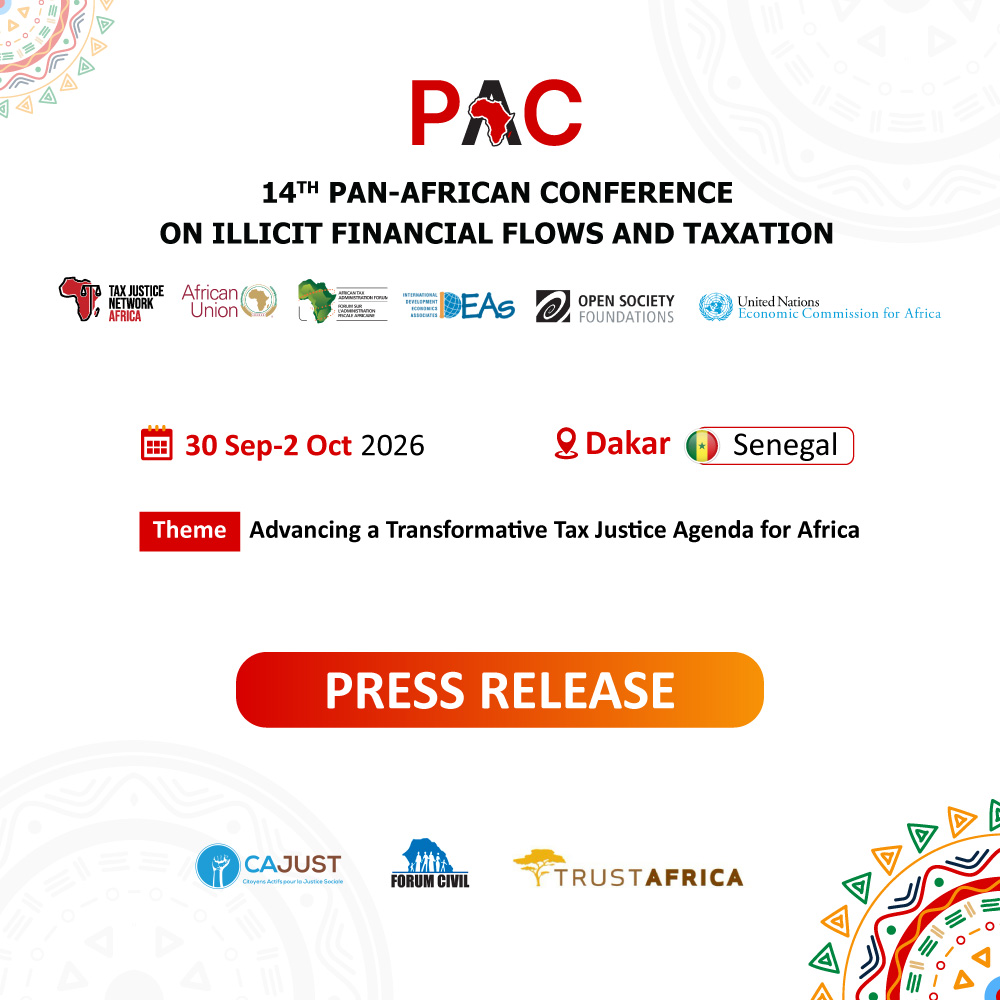
This is why the framing of the 14th Pan-African Conference on Illicit Financial Flows and Taxation (PAC 2026) around a “Transformative Tax Justice Agenda for Africa” is both timely and important. It invites us to move beyond seeing taxation primarily as a mechanism for raising revenue and to ask a more fundamental question: what kind of economies and societies should African tax systems contribute to building?
Why Fairer Taxation Alone Is Not Enough
For decades, African tax justice advocacy has rightly focused on stopping illicit financial flows, combating tax avoidance and evasion, increasing domestic resource mobilisation and ensuring that multinational corporations pay their share. These struggles remain essential. Africa cannot finance its development while enormous amounts of wealth generated on the continent continue to flow elsewhere.
It would be a historic and significant achievement for Africa to secure its due share of tax revenues generated from economic activities on the continent. However, this alone would not be enough if the underlying development paradigm and structures of production remain fundamentally unchanged.
Many African economies continue to occupy a subordinate position in an asymmetric globalised economy: exporting raw materials and other products with low value addition while importing manufactured goods, technologies and higher-value products. Extractive industries operating on the continent generate substantial profits, largely for foreign owners, without creating sufficiently strong domestic productive linkages, decent employment or technological capabilities.
In such circumstances, even a more effective and equitable tax system risks becoming primarily a mechanism for collecting and, at best, fairly redistributing a share of the proceeds generated by an economic structure that remains externally dependent.
A transformative tax justice agenda must therefore connect the question of the tax system with the equally important question of what kind of development strategy and economic trajectory taxation should encourage, discourage and ultimately help to transform.
Tax Policy as a Tool for Structural Transformation
Tax policy can support industrialisation and domestic value addition. It can disincentivise rent-seeking and incentivise investment in productive capacity rather than the extraction and transfer of profits. It can discourage speculative and environmentally destructive activities while supporting employment-generating sectors. It can effectively close loopholes in the tax system to curb illicit financial flows. It can prevent excessive concentrations of wealth and economic power that make equitable development impossible. And it can ensure that natural resources contribute sustainably to long-term economic diversification, rather than being depleted for the benefit of a few, to the detriment of the many and of future generations. But tax policy can fulfil this transformative role only if it is integrated into a holistic development strategy and a coherent broader policy framework.
This means moving beyond viewing taxation in isolation or simply as a tool for raising revenue. Structural transformation requires coherent and mutually reinforcing policies across taxation, trade, investment, industrial development, finance and technology.
Consider, for example, Africa’s largely negative experience with the use of tax incentives to attract foreign investment. Such incentives should be judged not simply by whether they attract investment, but by whether that investment creates decent jobs, develops domestic suppliers, facilitates technology transfer, increases local value addition and contributes to economic diversification. It would be neither a misrepresentation nor an exaggeration to conclude that, too often, African countries have sacrificed much-needed public revenue through such incentives while reproducing the very economic structures they urgently need to transform.
But structural transformation is ultimately not a technical question alone. It is a question of changing internal and external power relations. Tax systems reflect political and policy choices about who contributes, who benefits, which economic structures are maintained or transformed, which economic activities are rewarded or discouraged, and how resources and power are distributed. Transformative tax justice therefore requires confronting the domestic and international power relations and vested interests that benefit from, reproduce and sustain existing economic structures and outcomes.
The international dimension is particularly important. African countries cannot achieve transformative tax systems through domestic reforms alone when international rules have historically constrained their policy space and privilege the interests of wealthier countries and multinational corporations. The ongoing negotiations towards a UN Framework Convention on International Tax Cooperation (UN Tax Convention) therefore represent far more than a technical discussion about international taxation. They are part of a wider political struggle over who has the right to tax, who controls and benefits from the wealth generated by the global economy, and who has the power to make the rules. At stake is whether the existing asymmetry in taxing rights, resources and economic power between countries will be reproduced under a new institutional framework, or whether the Convention can become an instrument for fundamentally rebalancing those relationships and expanding the policy space African countries need to pursue their own development and structural transformation.
The engagement and collective leadership of African countries in these tax negotiations should therefore be linked to a larger political objective: only a similar level of collective engagement and leadership in the struggle to transform the broader global financial and economic governance architecture can expand the policy and fiscal space African countries need to pursue their own development strategies and structural transformation. This requires Africa not merely to participate in setting global rules, but to engage in a persistent collective political struggle to shape those rules and challenge the asymmetries embedded in the existing international financial and economic architecture.
PAC 2026: Turning Tax Justice into a Political Project for Africa
This is where the 14th Pan-African Conference on Illicit Financial Flows and Taxation (PAC) 2026 can make an important contribution. Its call to connect taxation with industrialisation, redistribution, resilience, regulation and representation provides a strong basis for moving tax justice out of its policy silo and placing it at the centre of the wider political debate and struggle over Africa’s development strategy, economic sovereignty and structural transformation.
TJNA has played a vital and historic role advancing the tax justice agenda in Africa, combating illicit financial flows and challenging tax abuse by multinational corporations and wealthy individuals. It is therefore particularly encouraging to see PAC 2026 mark another historic step: anchoring tax justice firmly within Africa’s broader development discourse and struggle for structural economic transformation. This represents an important evolution of the tax justice agenda—from challenging the injustices of the existing global tax system to making tax justice an integral part of the struggle to transform the structures that produce inequality, extraction and dependency in the first place.
The challenge now is to turn this into the foundation of an ambitious political strategy for a paradigm shift and collective action: to build alliances across civil society and African institutions, mobilise citizens to confront entrenched interests, connect sectoral analyses into a coherent narrative for structural change, and demonstrate why changing international rules and norms across the wider global economic and financial architecture is essential if reforms to international tax rules through a UN tax convention are to create the conditions necessary for structural transformation.
Maintaining the status quo in these other arenas will continue to reproduce extraction, dependency and unequal economic relations. The outcome of Dakar should therefore be more than a communiqué. It should contribute to the emergence of a political project that connects tax justice with Africa’s broader struggle for productive transformation, economic sovereignty and greater control over its own development trajectory.
Tax justice can be transformative—but only if it becomes part of that broader struggle for Africa’s structural economic transformation.
The Author of this blog is Dr. Alemayehu is the Executive Coordinator of the Global Alliance for Tax Justice (GATJ). He previously served as the founding Chair of Tax Justice Network Africa. He participated and contributed to the debate around the structural transformation agenda of Pan-African institutions such as UNECA and members of the African Civil Society.
For more information about the Global Alliance for Tax Justice (GATJ, please contact Alexandra Wenzel at alexandra[@]globaltaxjustice.org.
